
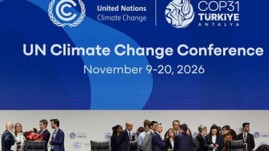
COP31 – it ended, but what is the current status of climate change
The COP31 United Nations Climate Change Conference (UNCCC) was held in November 2026; Antalya, Turkiye. It ended without the key overarching agreement regarding transition from fossil fuels (coal, oil and natural gas). There were “conflicts of interests” with some countries supporting a tougher language, while others felt the need to go slow and continue with the Paris Agreement (COP21:2015) pathway. Unfortunately, global warming continues with devastating effects, pollution has become endemic and land degradation has become alarming. The worry about fossil-fuel is that coal, oil and gas are extracted, consumed, cause pollution and eventually discarded. On the hand, renewable energy sources involve mining, manufacture, use, repair, reuse and recycle. The following is a summary of the climate and other environmental impact of the fossil-fuels compared to other energy sources:
| Energy source | Climate impact | Other environmental impact |
| Coal | Very high | Very high |
| Oil | Very high | Very high |
| Natural gas | High | High |
| Solar | Low | Medium |
| Wind | Low | Medium |
| Hydropower | Low | Medium |
| Geothermal | Low | Low |
According to the Climate Action Tracker (CAT) (https://climateactiontracker.org/), no country has yet reached the Paris Agreement <1.5oC compatibility in terms of lowering global warming as compared to pre-industrial levels. Secondly, countries are individually responsible for strengthening their 5-yearly Nationally Determined Contributions (NDC), but the Paris Agreement remains a legally binding. The net-zero greenhouse-gas (GHG) emission journey is not yet looking good, even though 2050 is still too far into the future. The biggest contributors to GHG are still far behind schedule (a) Critically insufficient: USA, Russia, Saudi Arabia (b) Highly insufficient: China, India, Canada, Brazil (c) Insufficient: South Africa, Japan, EU. CAT tracks individual countries that host 70% of the world’s population and these collectively contribute 85% of the global GHG emissions.
Conclusion: Uganda cannot immediately transition from oil and gas. As part of its Vision 2040 and Tenfold Growth Strategy, Uganda should responsibly mine oil, gas and other minerals, and the utilize the proceeds to develop infrastructure for the gradual transition to cleaner technologies. Consequently, oil, gas, solar, minerals should remain part of the diversified portfolio of resources that are extracted for economic development. Uganda expected to earn USD25billion per annum from oil, gas and critical minerals. Uganda is not one of the countries that receive a CAT rating. Nonetheless, it has its own 5-year NDC which was submitted to the United Nations Framework Convention on Climate Change (UNFCCC) in the year 2022. The next 5-year Uganda NDC is therefore targeted for submission in 2027. The current Uganda GHG emission reduction target is 24.7% below Business-As-Usual (BAU).
By CPA Dr. Albert Richards Otete
Student of Sustainability Assurancealbert.otete@jsamuelrichards.com


